
Berkshire, a county of royal connections, historic market towns, and picturesque countryside, is a place where history runs deep. From the imposing Windsor Castle to the mysterious Reading Abbey, the county is filled with stories of power, tragedy, and intrigue. These stories have left their mark on the landscape, and Berkshire is now home to a host of restless spirits. Join us as we explore ten of the county’s most haunted locations.
1. Windsor Castle
This imposing royal residence has a history stretching back over 900 years to William the Conqueror. While primarily a home to monarchs rather than a place of execution, the castle has accumulated an impressive collection of spectral residents.
The most famous is Herne the Hunter, a huntsman to Richard II who saved the King’s life by throwing himself before a charging stag. After being dismissed through court jealousy, he hanged himself from an oak tree in the Great Park, where his antlered ghost is still said to appear, traditionally as an omen of misfortune for England.
Henry VIII haunts the cloisters near St George’s Chapel, where he lies buried. Staff and visitors have reported hearing heavy footsteps, groans of pain, and occasionally glimpsing a large, shadowy figure: the phantom king still suffering from the ulcerated leg that plagued his final years. His second wife, Anne Boleyn, executed at the Tower of London, has been seen weeping behind a window in the Dean’s Cloister.
Elizabeth I appears in the Royal Library, dressed in black, walking across the room before vanishing into a wall. The late Queen Elizabeth II, her sister Margaret, and King Charles III have all reportedly witnessed her.
Guards have reported sudden temperature drops, unexplained footsteps, and doors slamming in the castle’s ancient chambers, particularly around the Curfew Tower, where Royalist prisoners were once held during the Civil War.
2. Reading Abbey
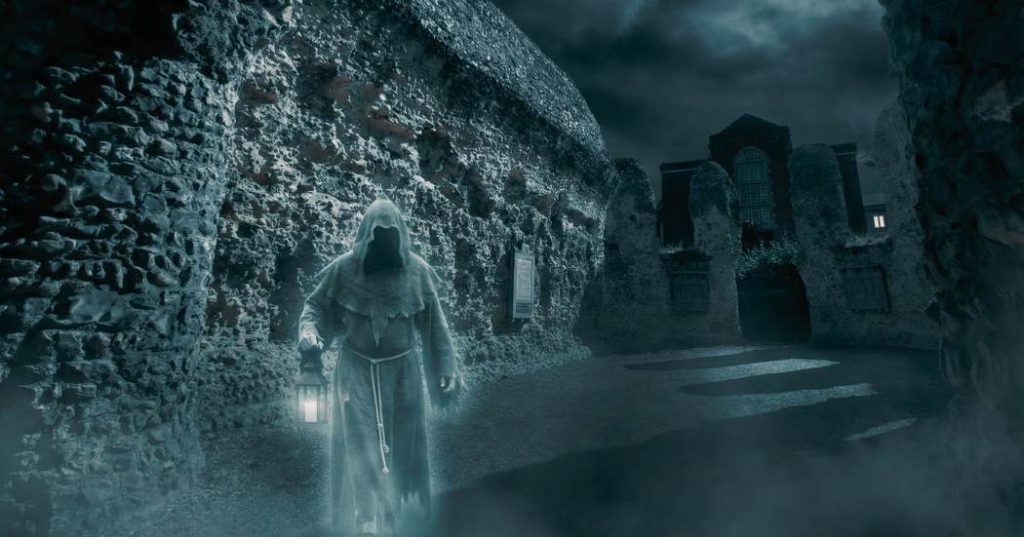
These atmospheric ruins are all that remain of one of medieval England’s greatest monasteries, founded in 1121 by Henry I. The king lies buried somewhere beneath the site, his exact grave lost after Henry VIII’s destruction of the abbey. His body was transported from Normandy with its entrails removed, sewn into a bull’s hide, and interred before the high altar.
The abbey’s final chapter was brutal. In 1539, Abbot Hugh Faringdon was dragged through Reading’s streets before being hanged, drawn and quartered outside the Abbey Gateway for refusing to surrender to Henry VIII. His body parts were displayed on spikes around the town.
Whether the martyred abbot or the lost King walks these ruins after dark, no one can say for certain, but visitors often remark on the strange atmosphere that lingers among the ancient stones.
The abbey’s romantic ruins and its ghostly tales make it a fascinating and atmospheric place to visit
3. Littlecote House
Littlecote House sits in 113 acres of beautiful grounds featuring stunning gardens, a heated pool, and a fully equipped gym. It is certainly a luxurious setting for a weekend away in the Berkshire countryside. However, paranormal investigators and ghost hunters claim it is the third most haunted building in England and one of the most haunted spots in Berkshire.
Littlecote House is one of England’s longest and most disturbing haunted houses, one that can be traced through family history, court records, and early 20th-century journalism rather than modern paranormal fashion.
The house dates back to the Tudor period and occupies land known to have been settled during Roman times. Yet its haunted reputation centres not on vague apparitions, but on a specific and enduring legend associated with the Popham family, former owners of Littlecote, and a crime said to have taken place in the late 16th century.
A detailed version of this tradition was published in 1929 under the title “The Ghost of Littlecote – A Strange Family Tradition”. According to the account, an elderly village nurse was summoned late one November night and forcibly taken, blindfolded, on horseback to Littlecote. There, she was led through dark passages and staircases to a bedchamber where a woman had just given birth.
While the nurse was tending to the child, a dark, violent-looking man entered the room, seized the infant, and murdered it by thrusting it into the fire. The nurse was paid, threatened with death should she speak of what she had witnessed, and taken home under the cover of darkness. The following morning, she discovered the purse of gold she had been given was real, and later gave testimony before a magistrate, producing a piece of fabric she had cut from the bed curtains as evidence.
This tradition became firmly attached to Wild Will Darrell, owner of Littlecote at the time, whose name appears repeatedly in historical records as a violent and corrupt figure. Darrell was later implicated in other crimes and narrowly escaped execution. Though never convicted of the infanticide, suspicion clung to both the man and the house, and the story passed into local memory as fact rather than legend.
It is from this account that Littlecote’s most persistent ghost stories emerge.
Witnesses over the centuries have reported:
- A Grey Lady believed to be the murdered child’s mother, seen wandering the house or grounds in distress
- The sound of a baby crying, most often associated with a specific bedroom long regarded as the most active in the house
- A shadowy female figure rocking an unseen infant
- Dark male apparitions linked to Tudor-era clothing
- Roman soldiers reportedly seen moving across the grounds, suggesting a much deeper historical layering
One of the most curious modern sightings is that of a large black dog, often seen sitting on the Jerusalem Staircase. It appears solid and lifelike, yet vanishes when approached, adding another unexplained element to an already complex haunting. In 1990, UK TV programme ‘Strange But True’ filmed two episodes there; here is the first episode.
Unlike many haunted houses, Littlecote’s reputation does not rest on fleeting shadows or recent ghost-hunting claims. It is rooted in a story that was already considered old and credible by the early 20th century, passed down through generations of the same family, and reinforced by historical records (and TV shows) that suggest something deeply wrong once occurred within its walls.
4. South Hill Park & The Wilde Theatre
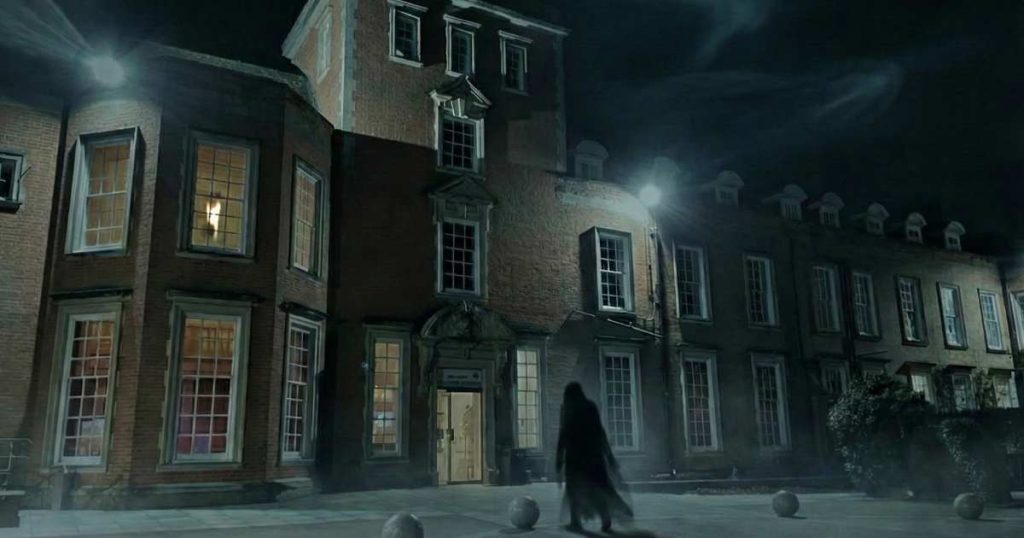
South Hill Park is best known today as a thriving arts centre, but beneath its cultural success lies a long history that has repeatedly attracted claims of paranormal activity. The original mansion, which forms the heart of the site, dates back several centuries and has been associated with periods of illness, decline, and death among former residents.
In December 1984, local newspapers reported that the newly opened Wilde Theatre was believed to be haunted. A Bracknell fireman and paranormal investigator, Jeff Nicholls, stated that he had spent several nights investigating the theatre following reports from staff.
According to the article, theatre employees described hearing unexplained footsteps and other strange sounds, even when the building was empty. Nicholls suggested that the activity could be linked to the older South Hill Park mansion, theorising that whatever haunted the historic house may have carried over into the new theatre space.
More recent accounts from visitors and staff continue to echo these earlier reports, with repeated references to unexplained noises, a sense of being watched, and movement within the building after hours.
5. Eton College
Founded by Henry VI in 1440, Eton College has amassed its share of spectral tales over nearly six centuries. However, its ghost tradition is quieter and more restrained than that of many historic institutions.
The college’s most famous supernatural resident is Jane Shore, mistress to Edward IV, who manifests as a Grey Lady in Lupton’s Tower and the Cloisters. Legend holds that Shore intervened to save Eton from closure when Edward annulled the school’s grants after deposing Henry VI. She allegedly died in the tower in 1526, and her dark figure has been glimpsed on the stairs by residents of the Cloisters, notably during the 1950s. Two portraits believed to depict her still hang in the Provost’s Lodge.
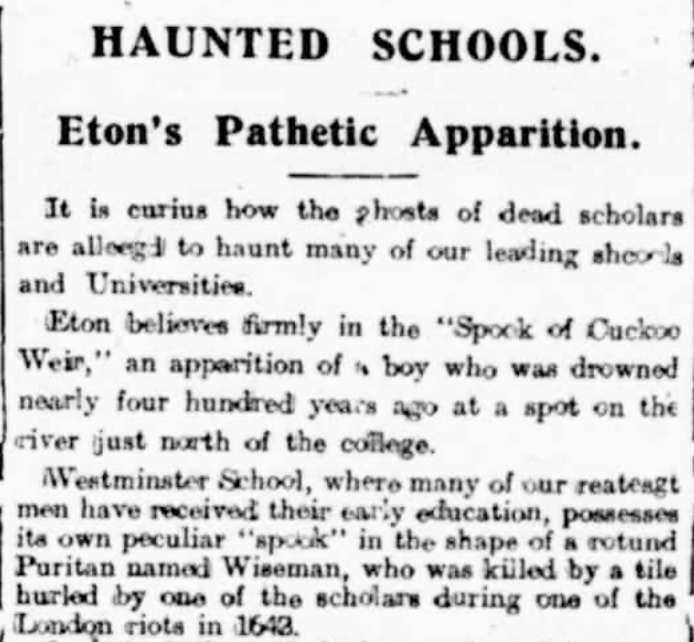
Less well known, even among ghost researchers, is the “Spook of Cuckoo Weir.” A 1917 newspaper account describes the story as already firmly believed at Eton: the apparition of a boy who drowned “nearly four hundred years ago at a spot on the river just north of the college.” Cuckoo Weir was historically one of several bathing spots used by Eton boys, and drownings were not uncommon before water safety measures were introduced in the 1840s. The ghost was regarded less as a source of terror than as a melancholy presence tied to a real place and a real danger.
The atmosphere of such stories later found literary expression through M.R. James, one of Britain’s most influential ghost story writers, who served as Provost of Eton from 1918 until his death in 1936. James set several tales at the college, including “After Dark in the Playing Fields” and “Wailing Well,” the latter written to terrify Eton Boy Scouts around a campfire. While his stories are fiction, they reflect an intimate knowledge of the traditions, anxieties, and buried histories of places like Eton.
6. Bisham Abbey
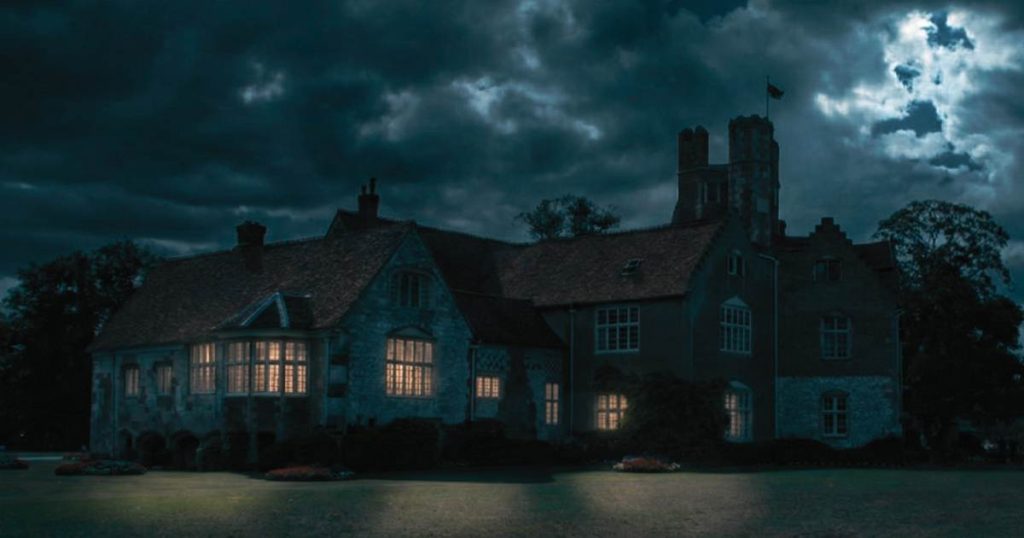
Sitting on the banks of the Thames near Marlow, Bisham Abbey is widely regarded as the most haunted house in Berkshire. Unlike many such claims, the haunting here centres on a single ghost, though she appears with remarkable frequency. Her story, a tale of pride and remorse, has been told for nearly two centuries.
The ghost is Lady Elizabeth Hoby, one of the most formidable women of the Elizabethan age. Daughter of Edward VI’s tutor, she was educated in Greek, Latin and theology, and counted Queen Elizabeth I among her personal friends. She was also renowned as strict and uncompromising. After the death of her first husband, Sir Thomas Hoby, in 1566, she oversaw her children’s education herself with exacting standards.
According to the legend that emerged in the 19th century, one of her younger children struggled with his lessons and constantly blotted his copybooks. One day, enraged by yet another ruined page, Lady Hoby beat the boy severely and locked him in the tower room, ordering him to complete his work. A messenger arrived summoning her to court, and Lady Hoby, ever conscious of her position, left immediately for Windsor. She remained there for several days. When she returned, she discovered the child had died alone in that tower room, apparently forgotten by the household.
The identity of this child remains genuinely mysterious. Historical records show no son named “William” among her children, though the name appears in most tellings of the tale. Around 1840, workmen renovating the abbey allegedly discovered Tudor copybooks hidden beneath the floorboards, one of them badly blotted. The books subsequently vanished, and their existence has never been verified.
What is verified is the haunting itself. Lady Hoby’s ghost has been seen many times since she died in 1609, always wringing her hands or washing them in a spectral basin that floats before her. Admiral Edward Vansittart, a later owner, encountered her in the room where her portrait hung, only to find the canvas mysteriously empty when he turned to look. She is known to manifest at times of coronations, as though seeking absolution for choosing her monarch over her own child. Her sobbing has been heard in the upper corridors, and lights are seen in the empty tower room.
My Experience at Bisham Abbey
I am one of the few ghost researchers to have investigated Bisham Abbey. In the early 2000s, I took part in a series of overnight investigations at the site. Strange sounds and unexplained noises were heard, though I saw nothing definitive inside the building itself.
My most memorable experience came not within the abbey’s walls but beside the Thames at five o’clock on a summer morning. Mist clung to the river as the first light of dawn began to illuminate the historic house. Through the haze, I saw the silhouette of a man standing on a punt. I watched for some time, waiting for him to emerge from the mist, but he remained just out of sight, never resolving into clarity. Within half an hour, the mist had lifted entirely, revealing the opposite bank in full. There was no boatman to be seen.
To this day, I cannot say whether I was looking at the outline of tall bullrushes playing tricks in the half-light, or whether a ghostly boatman, unrecorded in the annals of Bisham’s hauntings, had briefly made himself known.
7. Ashdown House
Rising from the Berkshire Downs like a Dutch doll’s house, Ashdown House is one of England’s most romantic buildings, and its reported hauntings are steeped in that same melancholy. The house was built in the 1660s by William, Earl of Craven, for Elizabeth Stuart, the exiled Queen of Bohemia, whom he had loved devotedly for decades. She never saw it. In 1662, before construction was complete, Elizabeth caught pneumonia and died in London. Craven, heartbroken, finished the house anyway and filled it with her portraits. He never married.
Ashdown’s most frequently reported apparition is often identified as Lord Craven himself. Witnesses have described a dishevelled figure in faded, much-patched finery, seen pacing the parkland before returning to the house, where he sits alone before a fireplace. In the ballroom, he is said to dance with an invisible partner. At the dining table, he appears to entertain unseen guests. There is something unbearably sad in these accounts: a man endlessly replaying a life that never unfolded as he hoped.
A female figure in 17th-century dress has also been reported in the upper rooms. Historical novelist Nicola Cornick has described seeing a woman standing at an upstairs window, followed by lights moving from room to room as though carried by candlelight. Only later did she realise the windows were shuttered. Another visitor reported being addressed by a woman in period costume who said, “I’m so glad you’re back,” before vanishing. Many assume this figure to be Elizabeth of Bohemia herself, though it would be unusual for her to haunt a house she never knew in life.
The great front door is known to open by itself, startling tour groups, and those who climb the famous staircase, lined with portraits of Elizabeth and her children, often report the distinct sensation that they are not alone.
8. The Berystede Hotel, Ascot
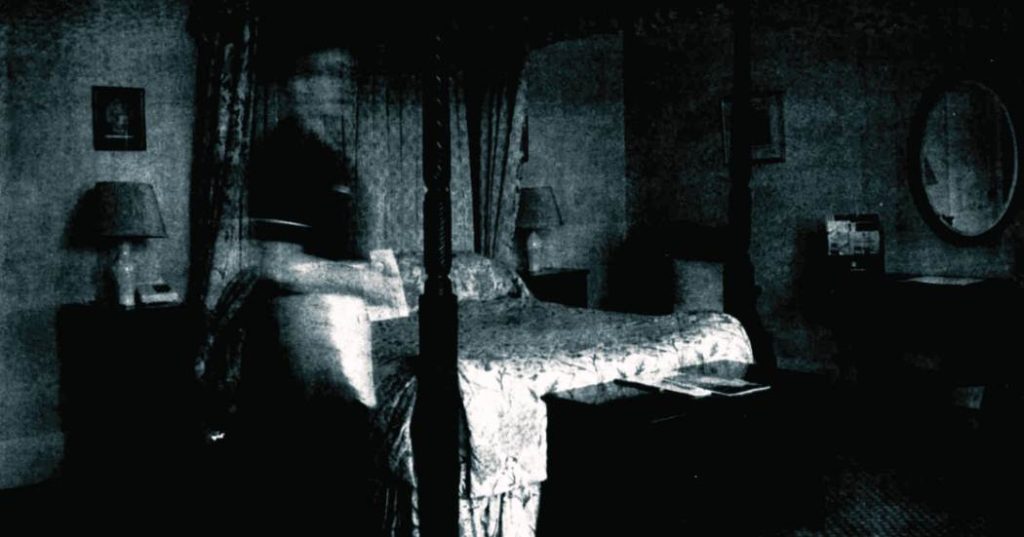
This Victorian country house hotel near Royal Ascot has been haunted for well over a century by one of Berkshire’s most benign ghosts, and one whose existence is unusually well-documented, right down to her death certificate.
The original Berystede was built in the 1870s by Henry and Hélène Standish, close friends of the Prince and Princess of Wales (later King Edward VII and Queen Alexandra). In their service was a loyal lady’s maid named Eliza Kleininger, who over years of faithful work, had accumulated a collection of jewellery – precious gifts from her grateful mistress.
In the early hours of 27 October 1886, fire swept through the house. As the blaze took hold, Eliza ran back into the thick smoke and flames to retrieve her treasured trinkets. It was the last time she was seen alive. The next morning, her charred remains were discovered at the foot of the servants’ staircase, surrounded by the jewels she had very nearly saved.
Eliza has remained at the Berystede ever since. Staff have reported seeing a lady in white gliding through the corridors, always in the early hours of the morning – the same time the fire raged. She appears most frequently in the area where she died, beneath what was once the servants’ staircase. Rooms 306, 361 and 362 are said to be particularly active.
Those who encounter her describe a pleasant, unthreatening presence. As one hotel manager noted in 1988, she “never does anything bad” – though at least one guest has complained of having their jewellery disturbed during the night. Perhaps Eliza, still searching for her lost treasures, cannot resist taking a closer look.
9. Ufton Court
Ufton Court has never been a place for obvious ghosts. No shrieking spectres, no named ladies in white, no children racing along corridors. Its reputation is older, quieter, and stranger than that.
Writers in the late nineteenth century noted that, strictly speaking, no ghost had ever been seen at Ufton Court. And yet, they added, it was difficult to stand by that conclusion. Approaching the house at dusk, travellers reported seeing it illuminated from top to bottom, every window glowing warmly, as though a grand gathering were underway. To the eye, the place appeared alive with movement: guests arriving, servants hurrying along passages, lights passing from room to room. Not a sound was heard. Then, without warning, the scene vanished. Darkness fell, and the house stood empty once more.
The effect was so convincing that observers insisted it could not be dismissed as imagination, nor the product of overindulgence. A natural explanation might exist, they conceded, but whatever the cause, Ufton Court had an unsettling habit of persuading the viewer that it was occupied by something unseen.
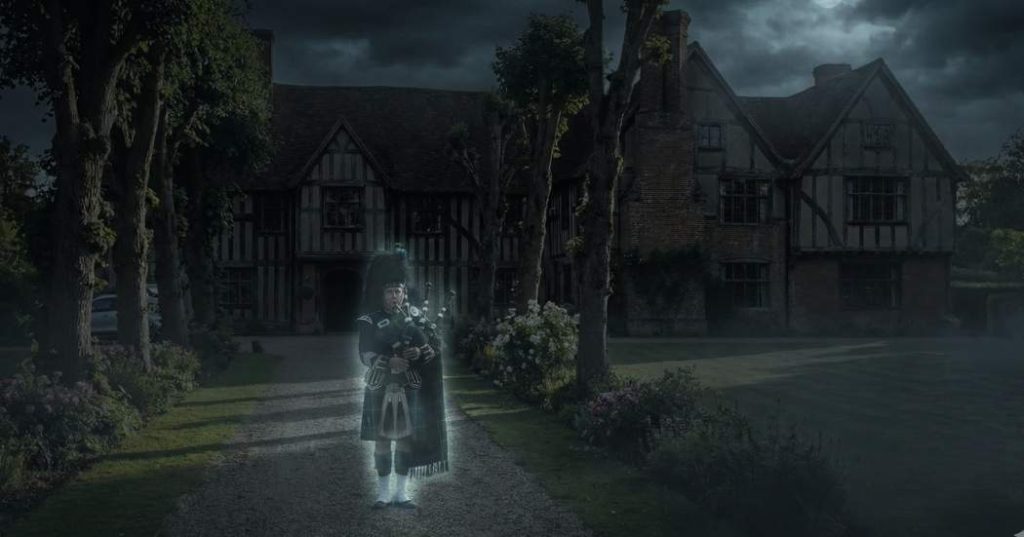
The house resurfaced in ghostly headlines again in the twentieth century. In the 1970s, reports circulated of a phantom piper heard at sunset, echoing an older legend that claimed a lone Highland piper once marched the paths of Ufton Court in the evening light. In one case, the mystery was neatly resolved when the piper turned out to be flesh and blood, playing nearby. The story was laughed off. But the legend itself was not new, and its persistence suggested that the house had long been associated with sounds and appearances that seemed to arrive on cue, then slip away.
Ufton Court’s history offers no shortage of shadows. In the late sixteenth century, it was raided in the aftermath of the Babington Plot, its Catholic owners imprisoned and ruined. Secrecy, fear, and sudden intrusion became part of the house’s fabric. It is perhaps fitting, then, that its hauntings are not figures that linger, but moments that appear fully formed and then disappear, leaving the observer uncertain of what they have just seen.
Ufton Court does not announce itself as haunted. It does not need to. It simply waits, and on occasion, shows itself briefly alive again, before closing its doors on the past.
10. Shaw House
Thomas Dolman built Shaw House in 1581 when he was a member of a wealthy Berkshire family who had made their fortune in the cloth industry. While I couldn’t find evidence of any historical hauntings (the house has been in private ownership for many years). The house is said to be very haunted, and there have been reports of multiple paranormal entities in the property. Some of the activities that have been documented there include mysterious balls of light, shadow figures, and even some disembodied screams that are heard throughout the building.
Visitors and paranormal investigators have reported experiencing sudden drops in temperature and witnessing unexplained phenomena throughout the property. Has the house’s long and troubled history left it with a host of ghostly residents?